
Most travel guides to New Zealand tick the same festival boxes: Waitangi Day, Matariki, maybe a mention of Napier’s Art Deco weekend. These are all genuinely worthwhile. But they’re also the safe, well-lit section of New Zealand’s event calendar — the part that appears on government tourism websites and Instagram feeds.
The more interesting calendar exists slightly to the left of all that. It’s a calendar where a rubber boot is a competitive throwing implement, where a woman’s home-brewed gorse flower wine launched one of the country’s most notorious annual events, and where hundreds of sheep regularly take over a main street while crowds cheer. These are not small, forgettable local curiosities. They are traditions that draw thousands of people, raise serious money, and say something genuinely true about the country that invented them.
Gumboot Day, Taihape — A Fictional Character Who Changed a Town Forever
The story of Taihape’s Gumboot Day begins, as many good New Zealand stories do, with a comedian named John Clarke.
Clarke often played a fictional character named “Fred Dagg” in his TV sketches. Dagg represented a stereotypical farmer from New Zealand — or, in Clarke’s words, a “Kiwi bloke.” As was the case with many farmers in the region, Dagg wore gumboots on his feet. Clarke had to choose a hometown for Dagg, and he decided on Taihape.
The small farming town in the central North Island, population around 1,600, seized the moment with both hands. Taihape seized on its moment on television and created an event to sell the town as a destination, and Gumboot Day created an opportunity to attract tourists and give them a reason to keep coming back.
Gumboot Day was first celebrated on April 9, 1985, devised by local business people who decided to capitalise on the town’s rural image. The concept was simple: throw a gumboot as far as possible, compete for prizes, eat something from a stall. But the event grew into something much more structured than that description implies. The rules were strict — the boot had to be a men’s size eight, available from a regular footwear vendor, and not modified in any way. This is a sporting competition, not a novelty activity.
The event now features the Skellerup World Boot Throwing Championships, with international competitors arriving from Germany, Finland and other countries. The world record throw stands at 165.4 metres, set by a New Zealand team. Two of the German throwers have been to Taihape eight times since they first came out to Gumboot Day in 2010 which tells you something about the quality of the hospitality. Competitors can qualify for Nationals and there is also a North Island Boot Throwing Championships held as part of the day.
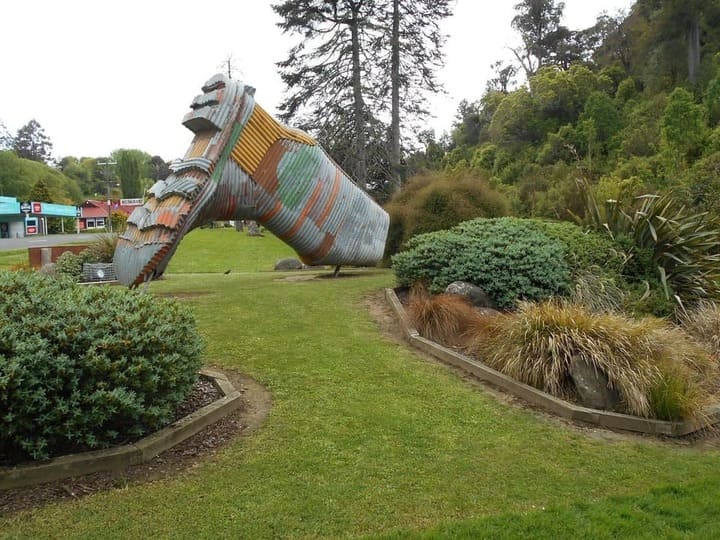
Taihape’s association with gumboots is marked by a large sculpture positioned prominently on the edge of town. Local business owners commissioned the New Zealand sculptor Jeff Thomson to produce the oversized gumboot using his signature material, corrugated iron. Even the permanent infrastructure of the town is shaped by a fictional character who once wore rubber boots on television. Gumboot Day is held each year on the Tuesday following Easter, at Taihape Memorial Park. Entry is by gold coin donation.
The Hokitika Wildfoods Festival — The Event That Started With a Bottle of Gorse Wine
The West Coast of the South Island has never been easy country. The rainfall is extraordinary, the sandflies are infamous, and the towns are small and separated by large distances of wild terrain. The Wildfoods Festival, held annually in Hokitika every March, is in many ways a direct expression of that environment — a celebration of eating things that require ingenuity and a certain absence of squeamishness to source.
The festival first came into fruition in 1990 when Hokitika local Claire Bryant instigated the very first celebration of local wild foods. Her wine cellar was very well stocked with a home brew of West Coast gorse flower wine and people were clamouring for a taste of her rose petal brew. The first festival in March 1990 coincided with Hokitika’s 125th anniversary and took place in a newly-developed heritage area on Gibson Quay in downtown Hokitika. The first Wildfoods had 30 stalls and attracted 1,800 people.
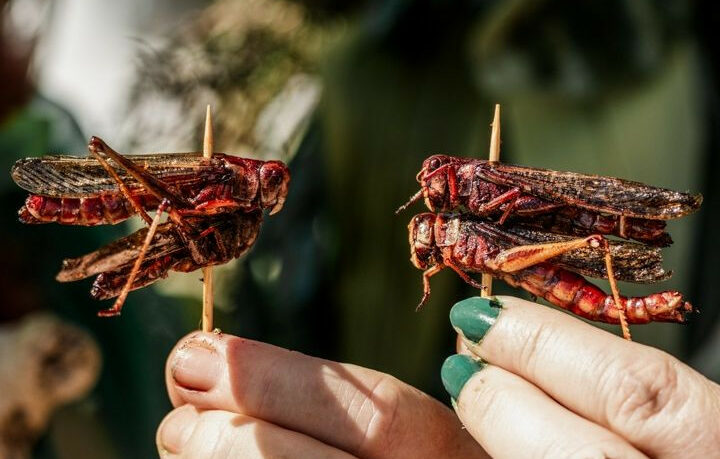
What it grew into is considerably harder to summarise for a general audience. The festival’s distinctive identity comes from the range of unusual foods available. Its most notorious offerings include huhu grubs, the larvae of the large New Zealand beetle Prionoplus reticularis, retrieved from rotten logs that are chopped up on site — sometimes served live to daring attendees, but usually cooked on a barbecue and described as “nutty and meaty” in flavour. Other standard menu items have included sheep testicles, pigs’ nipples, stallion semen shots dispensed from a syringe (with a microscope available to examine the contents), home-brewed moonshine, and — for those seeking a gentler experience — quality whitebait, smoked salmon, and traditional Māori hāngī.
By 2003, the festival was incredibly popular, with over 22,000 visitors, at a time when only about 3,500 people lived in Hokitika. The scale of that number — more than six times the town’s population arriving in a single day — caused logistical chaos and eventually led to a ticket cap of 15,000. In 2005, the Wildfoods Festival received a New Zealand Tourism Award in the Innovation category. A 2012 study showed that it brought about $6.5 million to the region each year.
Those with a creative flair can enter Feral Fashion — a wearable arts style competition modelled on racing circuit “Fashion in the Field” events, where contestants get creative, forage in their surroundings, and create a wild alter ego to wear to the festival. The Wildfoods Festival is part eating challenge, part carnival, part genuine community fundraiser — around 60 local groups run stalls for fund-raising purposes each year. One woman’s gorse wine has generated, cumulatively, tens of millions of dollars for a remote West Coast community.
The Running of the Sheep, Te Kūiti — Pamplona Without the Danger
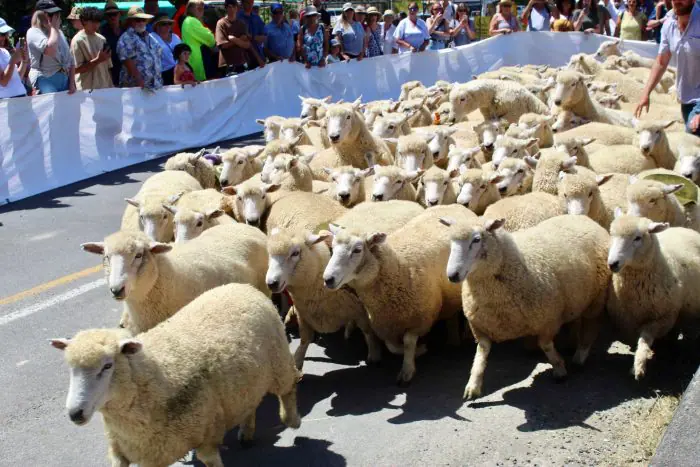
New Zealand has more sheep than people — roughly five to one, depending on the census. That ratio has shaped the economy, the landscape, and, it turns out, the event calendar. Nowhere is that more literally demonstrated than in Te Kūiti, a small town in the King Country region of the North Island, where every April, hundreds of sheep run down the main street while thousands of spectators watch from the footpath.
Te Kūiti’s annual festival — the Great New Zealand Muster — is a celebration of the rural township’s self-proclaimed title of “Shearing Capital of New Zealand”. International visitors plan their holidays around the Muster and the New Zealand Shearing Championships.
The sheep are trucked in from well-known shearing champion Neil Fagan’s farm. They are unloaded at one end of the main street, run halfway down where there’s a brief demonstration, then carry on to the other end before being trucked home again. The whole event takes a few minutes. People travel from across the North Island to watch. It’s the opposite of spectacle on paper, and completely compelling in practice.
A towering statue of a shearer presides over Te Kūiti, and a shearing competition features champion shearers — skilled athletes who can process more than 700 animals a day. The shearing competition is the serious core of the weekend. Competitors shear full-sized ewes in under a minute, one right after another — a physically demanding sport that takes skill, serious strength, and endurance. Watching a world-class shearer work is one of those experiences that recalibrates your assumptions about what constitutes athletic skill.
The Running of the Sheep has not always run smoothly. The event was cancelled one year due to health and safety and animal welfare concerns — when sheep get scared, they can form a mob and there is a risk of smothering. The council listened, adjusted the management plan, and the event returned. The Great NZ Muster runs annually, filling Te Kūiti’s main streets with musicians, children’s activities, arts and craft stalls, and culinary delights. Entry to the Muster is free.
New Zealand’s Oddest Annual Events
For those planning a trip around these events, here’s a practical reference:
- Gumboot Day, Taihape — Tuesday after Easter, Memorial Park, Taihape. Gold coin entry. Boot throwing lane available year-round at The Outback behind the main shopping centre.
- Hokitika Wildfoods Festival — Second Saturday of March, Cass Square, Hokitika. Ticketed event (cap of 15,000). Book early — accommodation in Hokitika sells out months in advance.
- The Great NZ Muster & Running of the Sheep, Te Kūiti — Early April, Te Kūiti main street. Free entry. Running of the Sheep begins at 2pm. Runs alongside the NZ Shearing Championships (ticketed separately).
- Ōamaru Victorian Fete, Ōamaru — November, Ōamaru Victorian Precinct. Features penny farthing riding, book binding, Morris dancing, and period costume throughout.
- Ōamaru Steampunk Festival, Ōamaru — June, Ōamaru town and Steampunk HQ. The town holds the Guinness World Record for the largest gathering of steampunks.
What Competitor Content Gets Wrong About These Events
Reading through what other travel sites publish on this topic, the pattern is consistent: events like Gumboot Day get a sentence. Wildfoods gets mentioned for shock value — “they eat horse semen!” — and nothing more. The Running of the Sheep barely appears at all.
What’s consistently missing is the underlying logic. Every one of these events was created in direct response to a specific local reality. Taihape needed economic reasons for people to stop. Claire Bryant had more gorse wine than she could drink alone and a community that needed celebrating. Te Kūiti is surrounded by sheep country and wanted to honour the skilled work that sustains it.
These aren’t arbitrary festivals invented to fill a weekend. They are compressed expressions of place — events that couldn’t exist anywhere else in the world because they grow directly out of a specific landscape, a specific economy, and a specific sense of humour. The gumboot is not just a prop at Gumboot Day. It’s the actual footwear of the actual people who built the town around it.
That’s the difference between a novelty and a tradition. New Zealand’s odd festivals mostly qualify as the latter — and that’s what makes them genuinely worth going out of your way for. Discover some of the strange laws that go hand in hand with quirky traditions in The Strangest Laws in New Zealand You Won’t Believe Exist.