
There’s a specific kind of joy that happens when you pull over on a New Zealand highway not because you planned to, but because something strange and wonderful forced your hand. A giant orange vegetable. A fence draped in hundreds of bras. A town where the tourist information centre is shaped like a sheepdog. You didn’t read about it in a guidebook. You just saw it, laughed, and turned the wheel.
New Zealand has a long tradition of this kind of roadside humour — monuments to local produce, sculptures built to save dying towns, fences that became causes, and structures that began as accidents and became icons. Most travel content about NZ road trips focuses on viewpoints and sandfly warnings. This article is about the other stuff: the things that catch you off guard, make no obvious sense, and stay in your memory long after the dramatic scenery has started to blur together.
Ohakune’s Giant Carrot — A TV Commercial That Became a National Monument
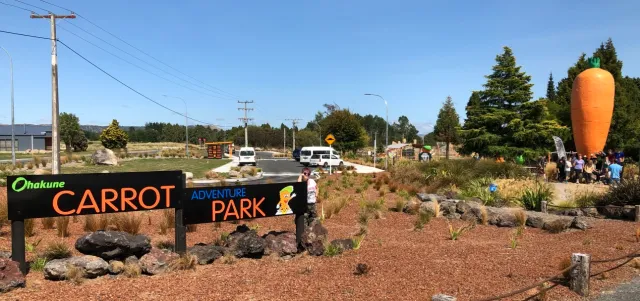
Pull into the small town of Ohakune on the southern edge of Tongariro National Park and the first thing you’ll see, towering above the entrance, is a very large orange carrot. Not figuratively large. At 7.5 metres tall, this is a very large model of the tasty orange vegetable and has been installed in the same spot since 1984.
The origin story is better than most roadside attractions can claim. It was originally constructed as a prop for a television advertisement for the ANZ Bank in the early 1980s. After filming was complete, the carrot was donated to the town in recognition of the area’s reputation as the source of a high proportion of New Zealand’s carrots, and installed in its current position in 1984. Nobody asked for a permanent giant carrot. It was simply offered, and Ohakune said yes.
The agricultural backstory makes the tribute genuinely meaningful rather than arbitrary. Carrots were first grown in the area during the 1920s by Chinese settlers, who cleared the land by hand and explosives. Ohakune now grows two-thirds of the North Island’s total crop. A century of farming heritage, distilled into one fibreglass vegetable.
In 2011, the carrot was painted black for the Rugby World Cup hosted that year in New Zealand. That detail tells you everything you need to know about how seriously the town takes its vegetable. The carrot has since been joined by friends: Crimson King the swede, Sir Lancelot the Brussels sprout, Perla the Potato, and Panorama Parsnip a vegetable cast that makes the whole park feel like a low-budget Pixar film set in a volcanic plateau.
In 1998, the Big Carrot featured on one of a set of ten postage stamps depicting New Zealand town icons. A national postage stamp. For a carrot. This country, honestly.
Tīrau — The Town That Decided Corrugated Iron Was Art
Somewhere between Auckland and Rotorua on State Highway 1, there is a town of under 1,000 people that has earned itself the unofficial title of Corrugated Capital of the World. This is Tīrau — and if you drive through without stopping, you will regret it.
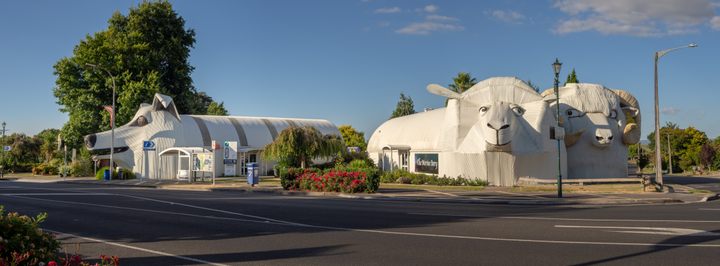
A giant dog and sheep tower over the main street of Tīrau, just two of a series of sculptures and buildings made from corrugated iron. The quirky sculptures were designed and erected by Steven Clothier of Corrugated Creations as part of an effort to revitalise the town from the late 1980s.
Clothier was a mechanic, not an artist. His father suggested that he build a corrugated iron dog, and he volunteered him to build it. He had never worked with galvanised steel sheets before, but the council commissioned it, and he unveiled his handiwork — a white pooch complete with a lolling tongue — three months later.
The Big Dog houses the i-SITE Visitor Centre, while the Big Sheep hosts a wool and craft shop in its stomach. Both were constructed in the 1990s, but the sheep came first and when it came time for the visitor centre to be constructed, it was designed to match. In 2016, a third building — a ram — was added. The resulting creature, made of nearly 500 feet of corrugated iron, is more detailed than its companions, featuring curved, three-sided horns, rounded tufts of wool, and a yellow ID tag on its ear.
What competitors consistently miss is the philosophy behind what Clothier built. “Tirau was one of those lil’ wee towns that you pass through on the way elsewhere,” Clothier says. That’s the exact problem he was solving. By the late 1980s, Tīrau, which had once been a thriving farming community, was in serious decline. A mechanic built three giant corrugated animals and reversed the decline of an entire town. That’s a better story than most cities can tell.
His creations gradually began to dot the country; some made their way across the Tasman Sea to Australia. In Putaruru, a giant meat pie sits on top of a bakehouse. In Auckland, a smiling strawberry waves at passing traffic near a berry farm. The corrugated iron art movement that started in a Waikato backyard has now spread across both islands.
The Cardrona Bra Fence — A Mystery That Became a Movement
Between Queenstown and Wānaka, on Cardrona Valley Road, there is a fence covered in hundreds of bras. Colourful, varied, occasionally accompanied by handwritten messages. Nobody fully knows how it started.
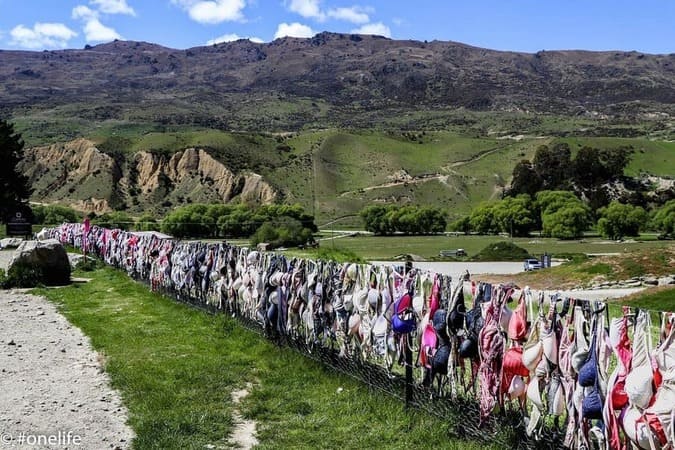
The Bra Fence began at some point between Christmas 1998 and New Year 1999, when four bras were attached to the wire fence alongside the road. The original reason for the bras being attached to the fence is unknown. One popular account holds that a group of women celebrating the new millennium at the nearby Cardrona Hotel attached them on their way home that night. Nobody has ever confirmed this. The fence simply appeared one morning, and grew.
It was like a viral social media post, but before social media took hold. People passing by decided to add their bra. And the bra fence just grew and grew. By February 1999 there were 60 bras. By October 2000, despite repeated anonymous removals, the number had climbed past 200. Each time someone cleared the fence, the story spread further and the replacements arrived faster.
The fence became controversial. In April 2006, after discovering the fence rested on public road reserve, the local Council determined the bra fence was a “traffic hazard” and an “eyesore”, and ordered the bras on the fence to be removed. The bras returned. They always returned. In November 2014, tour guide Kelly Spaans and her partner Sean Colbourne decided to take voluntary guardianship of the fence after it had been stripped by anonymous people on a number of occasions. They shifted the fence to their private driveway about 100 metres away from its original spot.
The relocation turned the fence from a roadside controversy into something more meaningful. A pink sign and a collection box were put up in March 2015 to help raise funds for the New Zealand Breast Cancer Foundation. In 2017, Bradrona had raised over $30,000 in charity funds. The Cardrona Distillery, now located next door, even produces a pink gin with a portion of proceeds going to the same cause.
What began with four anonymous bras on a winter night has raised tens of thousands of dollars for breast cancer research and received coverage on BBC London radio. What began as four bras clipped to a rural fencepost has grown into a colourful tribute to community spirit and breast cancer awareness. New Zealand being New Zealand.
Where to Find Them
Here’s a practical overview of the major roadside curiosities discussed in this article, including what to expect when you arrive:
| Attraction | Location | Why it exists | Best time to visit |
|---|---|---|---|
| Giant Carrot | Ohakune, State Highway 49 | Built for an ANZ Bank TV ad, gifted to town in 1984 | Any season — winter adds ski town energy |
| Corrugated Dog & Sheep | Tīrau, State Highway 1 | Built to revive a declining town from late 1980s | Midday — cafés and shops are open |
| Cardrona Bra Fence (Bradrona) | Cardrona Valley Rd, between Queenstown & Wānaka | Anonymous bras appeared in 1999, became charity landmark | Any time — parking area off the main road |
| Giant Salmon | Rakaia, South Island | Tribute to Rakaia’s salmon fishing reputation | Year-round, roadside stop |
| Giant Sandfly | West Coast, South Island | Ironic tribute to the region’s notorious biting insects | Only if you’re already on the West Coast |
The West Coast Sandfly — The Monster You Deserve
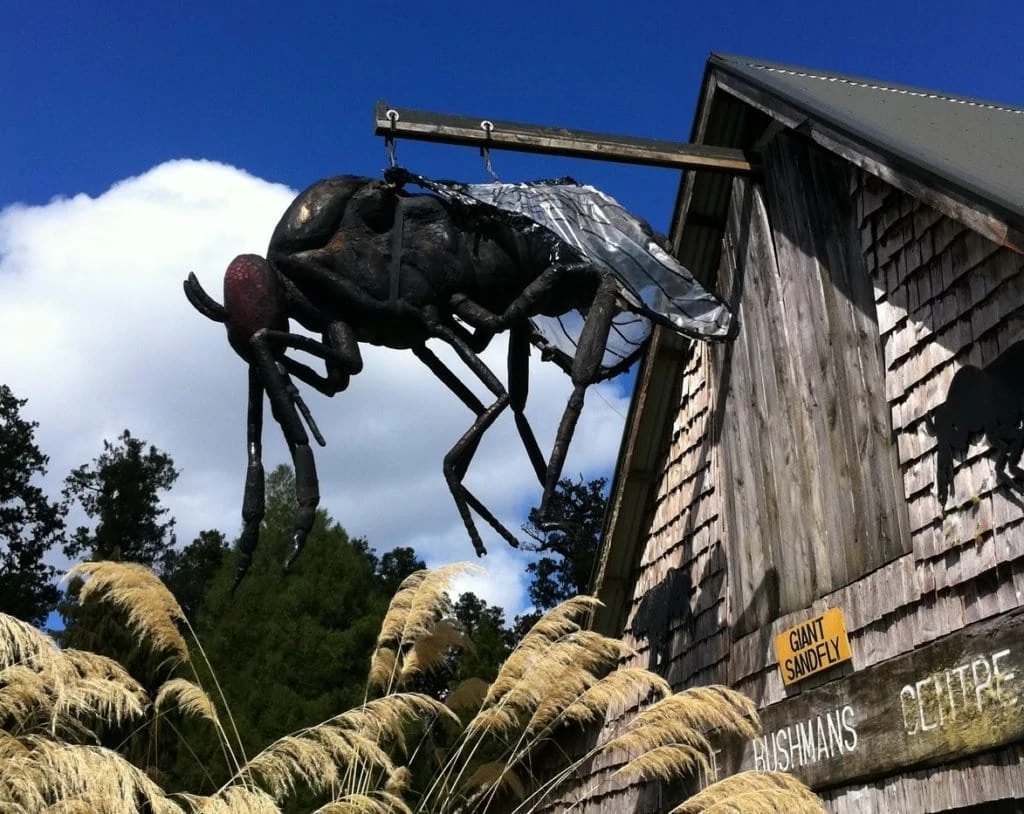
While we’re on the subject of unusual tributes: the West Coast region of the South Island erected a statue of a sandfly armed with a fork and knife. This is a region where the sandflies are so numerous and aggressive that they have genuinely shaped the tourism experience — most visitors spend significant mental energy managing them. Rather than pretend the problem doesn’t exist, the locals built an enormous version of the offending insect, gave it cutlery, and put it by the road.
That specific combination — self-awareness, dark humour, and a total willingness to celebrate the thing that makes your region difficult — is as New Zealand as anything else on this list. The sandfly statue doesn’t apologise for the sandflies. It owns them.
Why New Zealand Does This Better Than Anywhere Else
Go through competitor content on this topic and a pattern emerges quickly: most articles treat these roadside curiosities as a list of photo opportunities. A short description, some coordinates, move on. What they miss is the consistent logic running through all of these stops.
Almost every unusual roadside attraction in New Zealand was built by a regular person — a mechanic, a town council, a group of anonymous women leaving a pub — who decided to do something that made no obvious economic sense and turned out to matter enormously. Steven Clothier reversed a town’s decline with corrugated iron. Ohakune found an identity in a discarded TV prop. Bradrona raised $30,000 for breast cancer research from a fence that was nearly torn down repeatedly.
The scale is part of it too. New Zealand is a small country with a small population, which means individual acts of creativity have outsized visibility. A single eccentric idea, placed on a frequently-driven highway, gets seen by a disproportionate number of people. It accumulates meaning. It becomes a landmark. And then, somehow, it ends up on a postage stamp.
The best New Zealand road trips are the ones where you build in time to stop for things you didn’t plan for. The carrot, the corrugated dog, the fence of bras blowing in the Central Otago breeze — none of these will be in the itinerary you printed out. All of them will be in the stories you tell when you get home.