
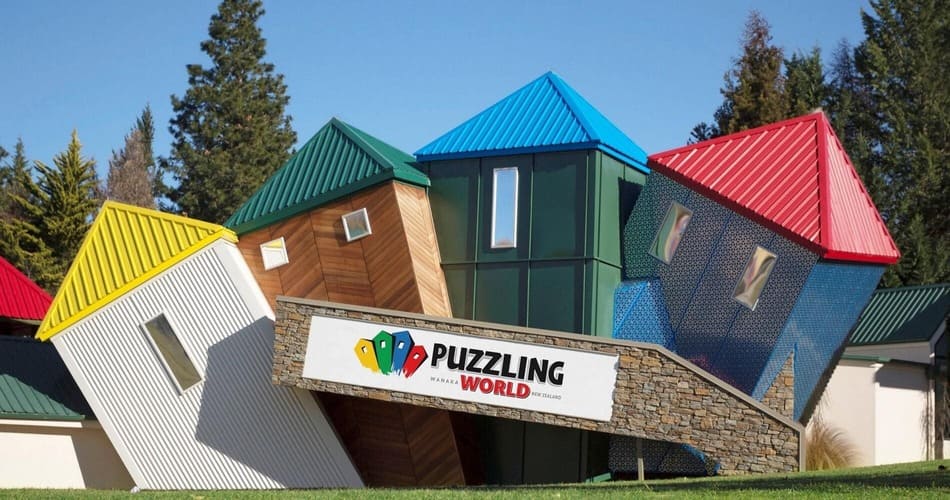
There’s a moment, somewhere between walking uphill on flat ground and watching water flow the wrong direction, when your brain simply gives up trying to make sense of the world. That moment happens at Puzzling World — and honestly, it’s one of the best feelings you can have on a New Zealand holiday.
Located just outside the lakeside town of Wānaka on the South Island, Puzzling World is one of those rare attractions that doesn’t need dramatic marketing. The place speaks for itself. It’s been doing exactly that since 1973, quietly bending the minds of visitors who came expecting a quirky roadside stop and left questioning whether they can trust their own eyes.
Most travel content covering this place tends to run through the same checklist — maze, tilted house, follow the faces, done. This article goes deeper. We’ll explore what actually makes Puzzling World work as an attraction, walk through everything on offer, and explain why this is not, as some listicles would have you believe, just a rainy-day activity for kids.
The Origin Story
Before we talk about what’s inside, it’s worth knowing how this place even came to exist — because the origin story is genuinely extraordinary.
When Stuart and Jan Landsborough sold their house to buy seven acres of barren land to build a maze in a town of just 800 people, many questioned their judgement. The bank had already refused them a loan. They went ahead anyway.
Six weeks, 12,000 wooden planks and a lot of hard graft later, “The Maze” opened on the outskirts of Wānaka just in time for the 1973/74 summer holidays. In its first year, they welcomed 17,600 people.
That’s a remarkable number for any new attraction — let alone one built in six weeks, in a remote South Island town, by two people who had staked everything they owned on the idea. A puzzle centre was added in 1979 and a second level added to the maze three years later. The over-bridges made it the world’s first 3D maze — a design concept that Stuart later exported globally. Taking his “Super Maze” concept global, Stuart then designed twenty-five similar mazes for Japan, USA, Australia and Auckland between 1985 and 1988.
In 2004 Stuart retired and handed the reins over to his daughter Heidi and son-in-law Duncan Spear, who have continued the theme of continual innovation. The attraction recently celebrated its 52nd year and its 5 millionth visitor — extraordinary milestones for what began as a wooden maze in a paddock.
The Great Maze: Deceptively Difficult
Let’s start outside, because the maze is where it all began and it’s still one of the most satisfying parts of the visit.
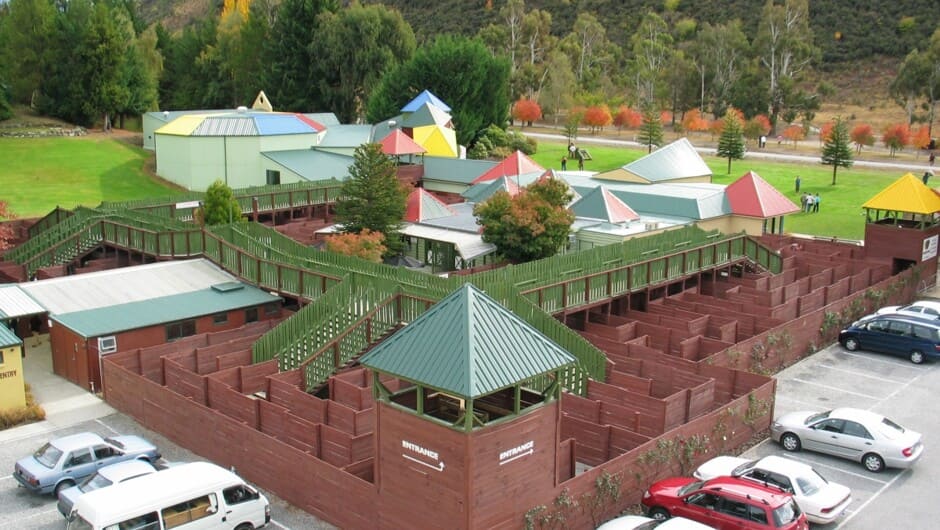
Challenge yourself, family and friends to a race around the Great Maze. That sounds simple enough. It isn’t. The park features a large maze in which the traveller must reach four coloured corner towers before finding the middle courtyard — emergency doors are included for those who struggle.
Those emergency doors are not decorative. People use them. The maze is genuinely tricky, built across multiple levels with overbridges and underpasses that create a three-dimensional puzzle rather than a flat grid. Families with young children should budget at least an hour. Competitive types may find themselves spending longer than they’d like to admit.
A lot of visitors mentioned needing at least three hours to fully enjoy everything across the whole site — so don’t treat the maze as a quick warmup.
The Illusion Rooms: Where Your Brain Goes to Fail
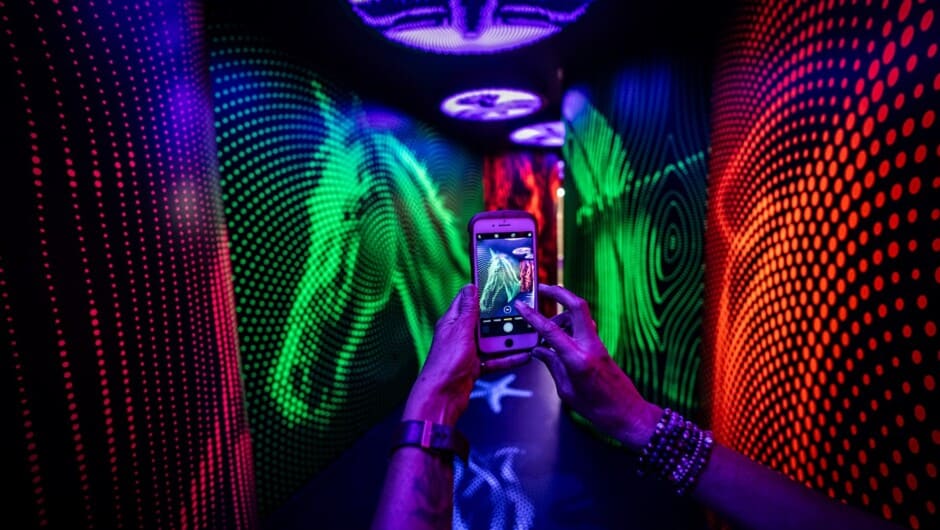
This is the heart of Puzzling World, and where most visitors spend the bulk of their time. With optical, sculptural and gravity-defying displays, the Illusion Rooms will test your reality. There are currently six of them, each built around a different principle of visual psychology. Here’s what you’ll actually find:
- The Tilted House is the one that catches everyone off guard. Built at a 15-degree angle, it contains illusions such as water apparently flowing uphill and a series of perceptual tricks that work because your brain trusts the room’s architecture more than the laws of physics. Once you’re inside a tilted building, your sense of “level” recalibrates to match the floor — and everything else becomes strange.
- The Hall of Following Faces is an octagonal room lined with famous faces that seem to follow you wherever you move. The effect works because the faces are back-lit hollow mask illusions on the walls, created by artist and sculptor Derek Ball. Concave objects, when lit from behind, appear convex to the human eye — a classic perceptual trick that remains eerie no matter how many times you’re told the science behind it.
- The Ames Room is a staple of optical illusion collections worldwide, but Puzzling World’s version comes with a twist. The irregularly shaped chamber — with one side taller and narrower than the other — tricks the eye into perceiving people as giants or dwarfs when viewed from a peephole, relying on angular distortion to manipulate height perception. There’s also a delayed video feed so you can watch yourself experiencing the illusion after the fact. That second viewing is somehow even stranger than the first.
- The Sculptillusion Gallery opened in 2012 and is the largest room on site. It contains impossible objects, perspective paintings and reversible figures. The sculptures include a tap seemingly suspended in mid-air and a floating bench, as well as architectural features such as a stone carpet and living wall, created by New Zealand sculptors and designers. The room also holds several works by the late American inventor and illusionist Jerry Andrus. The SculptIllusion Gallery was recipient of a national award in the New Zealand Commercial Building Awards 2014.
- The Glow Rooms — Glow Safari and Paradox Lane — are the newest additions, added as part of the 50th anniversary celebrations in 2023. The latest additions offer fully unique, immersive experiences with striking geometrical designs and optical trickery at play. These feel distinctly modern compared to the rest of the site and give the attraction a strong reason for repeat visits.
The Leaning Tower & Famous Toilets: Yes, Really
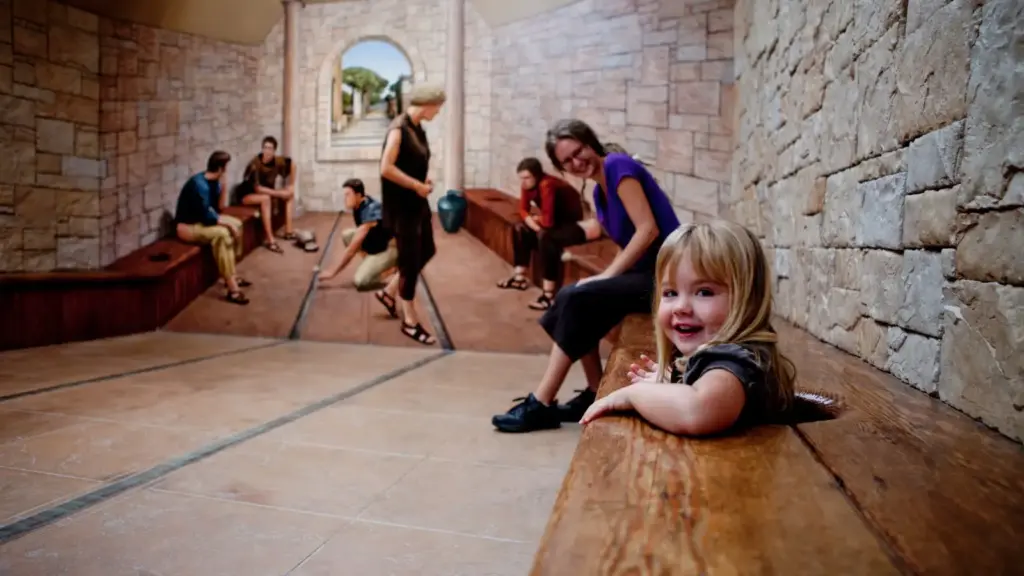
Outside the illusion rooms, the grounds of Puzzling World offer their own peculiar pleasures. The most photographed structure on site is the Leaning Tower of Wanaka. The tower is seemingly impossibly balanced on one corner, making the whole structure lean at an angle of 53 degrees to the ground. It was added in 1999 along with a backwards-running clock face on the exterior — another characteristic Landsborough touch.
Then there are the toilets. Even if you only pay a visit to New Zealand’s most unusual public toilets, your world will never be the same again.That’s not an exaggeration used for effect. The Roman-themed bathrooms have become a legitimate attraction in their own right, frequently cited in visitor reviews and used as an Instagram backdrop. It says something about the place that even the amenities are a talking point.
The Psychic Challenge: $100,000 Nobody Has Claimed
One of the most underreported aspects of Puzzling World is how philosophically pointed the whole enterprise actually is. Stuart Landsborough wasn’t just building a fun park — he was building a sustained argument in favour of critical thinking and skepticism.
Initiated in 1994 by Puzzling World’s founder, Stuart Landsborough — a longtime member of the New Zealand Skeptics Society — the Psychic Challenge originated as a counterpoint to the attraction’s theme of perceptual puzzles, aiming to foster critical thinking amid rising interest in pseudoscientific phenomena.
The operators of Puzzling World have for many years offered a monetary prize for anybody who can prove they have psychic powers; potential winners need to use their powers to locate a specific item located somewhere on the Puzzling World site. When the prize was doubled to $100,000 NZD, the radius for the hidden note was reduced to 100 metres. Any participant is required to pay $1,000 upfront — a requirement designed to filter out casual claimants.
Nobody has ever claimed the prize. The challenge sits quietly alongside the illusion rooms as a gentle reminder: the brain is easy to fool, but the rules of reality are harder to bend than they appear.
The Think Tank Café & Puzzle Shop
This is the part that surprises a lot of first-time visitors. The café isn’t just a place to eat between attractions — excited children and bemused adults pored over neatly arranged tables, tending not to their beverages, but instead to the puzzles that were set out on each table. Every table in the café comes equipped with physical puzzles, which means even a lunch break turns into a collaborative problem-solving session.
The gift shop carries puzzles, optical illusion art, and oddities you won’t find anywhere else — including the famous backwards clock, where the numbers run anti-clockwise and the hands move in reverse. It’s one of those items that seems gimmicky until you try to read the time and discover it’s genuinely difficult. If you’re planning a road adventure, Road Trips Off The Beaten Track: Curiosities by the Road will give you ideas for quirky stops along the way.
Who Is Puzzling World Actually For?
This is where most competitor content misses the mark. Puzzling World consistently gets filed under “family-friendly activity” or “rainy day option,” which is accurate but limiting. Landsborough credits his father with instilling in him an imaginative business sense and believes that part of the reason for the park’s earlier success is because he advertised to attract adults rather than children.
That philosophy shows in the design. The Ames Room, the Sculptillusion Gallery, and the Psychic Challenge all carry an intellectual weight that goes well beyond keeping children entertained for an afternoon. Adults who enjoy the psychology of perception, the philosophy of skepticism, or simply the pleasure of being baffled in a sophisticated way will find as much here as any eight-year-old navigating the maze.
The overall experience exceeded expectations and was described as mind-blowing by many visitors. That reaction tends to come from adults more than children — people who arrived expecting something modest and found themselves genuinely disoriented.
Practical Notes Before You Go
Puzzling World is located at 188 Wānaka-Luggate Highway, about two kilometres from the Wānaka lakefront and a one-hour drive from Queenstown. It’s open daily from 9am to 4:30pm. Combo admission offers the best rates for your visit to Puzzling World, with deals also available for families, seniors, groups, and schools.
Budget at least two to three hours for a full visit, longer if you’re bringing children. The maze and the illusion rooms together can easily fill an afternoon, and the café is a genuinely pleasant place to decompress afterwards. Parking is free and the site is compact enough to navigate easily without a map — though a map is provided if you’d like one.
Why It Works After 52 Years
Most tourist attractions that opened in 1973 have either closed, been sold to a chain, or quietly declined. Puzzling World has done the opposite — it’s grown, won national business awards, and recently celebrated its 5 millionth visitor. The Wānaka Maze was most popular between Christmas and New Year in those early days. Today, it draws over 200,000 visitors annually from around the world.
The reason it works is the same reason it worked in 1973: the core experience — being fooled by your own brain — never gets old. The science of optical illusions isn’t dated. The thrill of walking through a room that makes no physical sense is as immediate now as it was fifty years ago. After visiting Puzzling World, you might enjoy exploring Lost Libraries & Mini-Museums — NZ’s Quirky Micro-Attractions for more offbeat attractions.
Puzzling World is proof that the best tourist attraction is one built around a genuinely good idea, run by people who actually care about it. The Landsborough family staked everything on that idea, and the rest is a very unusual kind of history.