
New Zealand has been isolated from the rest of the world for roughly 80 million years. That’s not a number meant to impress — it’s the actual explanation for everything strange you’re about to read. When a landmass breaks away from a supercontinent and drifts into the Pacific, life on it follows a completely different evolutionary path. No land predators. No large browsing mammals. A whole island system free to develop at its own peculiar pace.
What emerged is one of the most genuinely unusual collections of wildlife on earth. Most travel content covers the kiwi and calls it a day. That’s barely getting started. Here’s a closer look at the creatures and plants that make New Zealand biology feel like a thought experiment — a glimpse of what the world might look like without mammals running the show.
Combine your nature adventure with Hidden Natural Wonders: NZ’s Secret Geological Marvels to see incredible geological sites.
The Glowworm — Not What Its Name Suggests
Let’s begin with New Zealand’s most famous natural light show, and immediately complicate it.
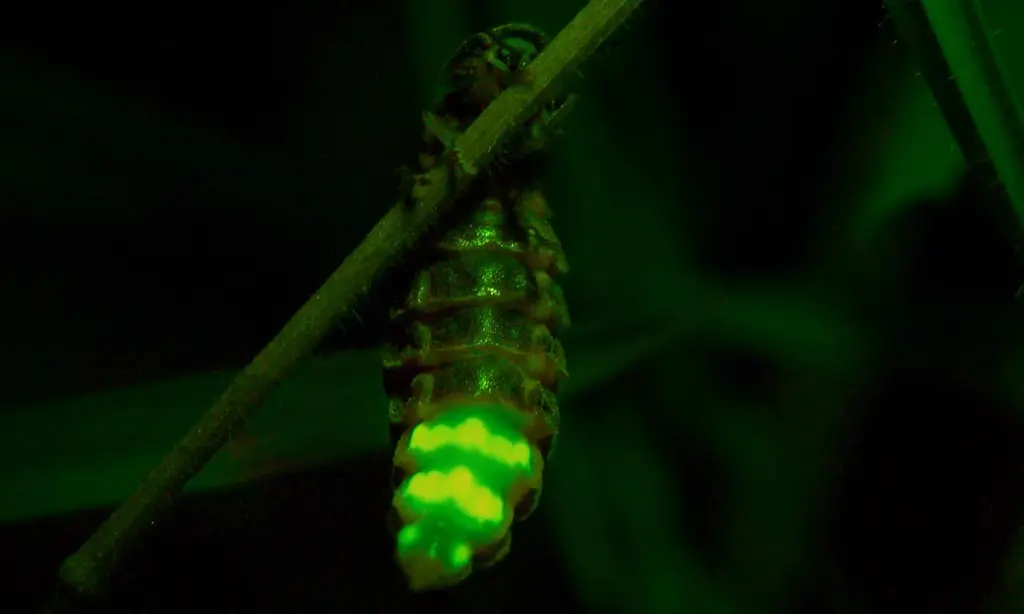
Arachnocampa luminosa, commonly known as the New Zealand glowworm, is a species of fungus gnat solely endemic to New Zealand. The larval stage and the imago produce a blue-green bioluminescence. Right there is the first thing most travel guides leave out: the glowworm is not a worm. It’s a gnat. And the beautiful blue light it produces comes from its larval stage — which, biologically speaking, makes it a glowing maggot. This changes nothing about how extraordinary it looks, but it does change how you think about it.
The blue-green glow reaches a maximum wavelength of 487 nm and is produced through a biochemical reaction involving a distinct luciferase enzyme and a specific luciferin molecule. Notably, the luciferase enzyme in glowworms differs from that found in fireflies, despite some similarities. These two creatures — the New Zealand glowworm and the European firefly — invented bioluminescence completely independently. The bioluminescent systems of glowworms and fireflies have distinct evolutionary origins. These two orders diverged approximately 330 million years ago during the Carboniferous period.
The light isn’t decorative. The larva spins a nest out of silk on the ceiling of the cave and then hangs down up to 30 silk threads along which it regularly places small sticky droplets. Insects flying through the cave are drawn toward what looks like a night sky, fly upward, and get tangled in the threads. It’s an elegant trap built by something roughly the size of a matchstick.
The Waitomo Glowworm Cave was first properly explored in 1887 by Māori chief Tane Tinorau and the English surveyor Fred Mace. Today it draws hundreds of thousands of visitors a year and is one of the most visited caves in the entire Southern Hemisphere. But Waitomo isn’t the only option. Glowworms can also be found in areas of native vegetation such as the Wellington Botanical Gardens which means you can see a genuine wild bioluminescence display without booking a tour or leaving the capital.
The Wētā — An Insect That Outlived the Dinosaurs
If the glowworm is New Zealand’s most beautiful creature, the wētā is its most unsettling. And also, arguably, its most extraordinary.
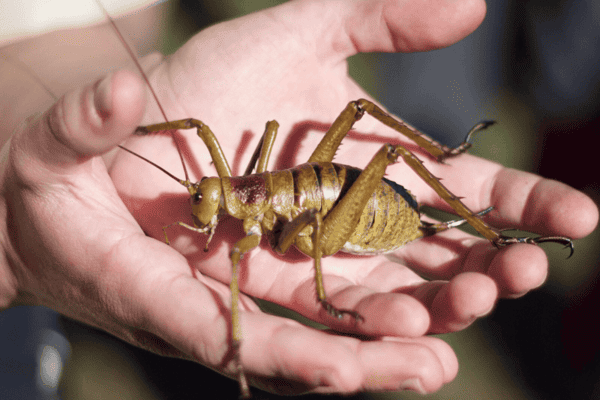
Wētā is the common name for a group of about 100 insect species endemic to New Zealand. They are giant flightless crickets, and some are among the heaviest insects in the world. Wētā have been around long enough to see dinosaurs come and go and to evolve into more than 100 different species, all of them endemic to New Zealand.
The giant wētāpunga is the showstopper of the group. When fully grown they can even be heavier than a mouse or sparrow. A captive giant wētā once reached a recorded weight of 70 grams — making it one of the heaviest documented insects in the world, heavier than a sparrow. The creature looks, to most people, like something from a low-budget horror film: large, spiny, with oversized hind legs and a face only an entomologist could love. In practice, the giant wētā is largely herbivorous and moves slowly enough that you could comfortably observe one for several minutes before it notices you.
The species has only survived on Hauturu-o-Toi/Little Barrier Island. Habitat destruction and the arrival of introduced predators saw to their disappearance everywhere else. They filled the role of rodents before land mammals came to New Zealand, although their behaviour and diet are quite different. This is the key to understanding the wētā’s existence: in a country without rats or mice for most of its evolutionary history, the ecological niche usually occupied by small mammals was filled by a very large insect.
The Mahoenui giant wētā, long considered extinct on the mainland, was rediscovered in a patch of King Country gorse in 1962. Gorse, introduced by Europeans as a pastoral crop, turned out — accidentally — to protect the wētā from predators. Conservation isn’t always tidy.
The Tuatara — The Reptile That Rewrites the Rulebook
Of all New Zealand’s endemic species, the tuatara may be the most scientifically significant animal on earth. That’s not an overstatement.
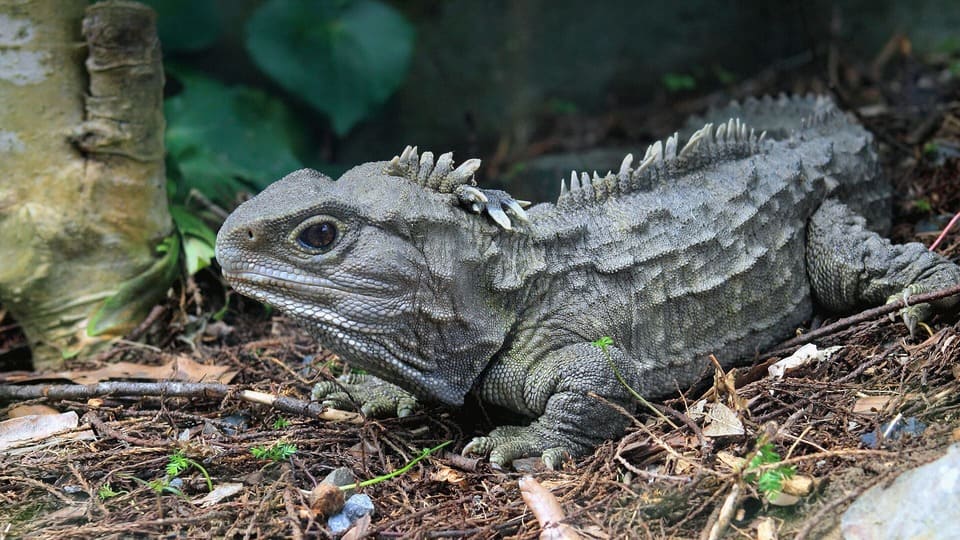
The tuatara is the sole surviving member of the order Rhynchocephalia, a type of reptile that was found across the globe during the Mesozoic, living alongside the dinosaurs. The rest of the Rhynchocephalia crew declined and eventually became extinct about 60 million years ago. Except the tuatara. It looks like a lizard. It is emphatically not a lizard. The tuatara and lizards diverged from a common ancestor about 250 million years ago — roughly 150 million years before snakes split off from lizards. For reference, humans are more closely related to kangaroos than a tuatara is to an iguana.
The biology gets stranger from there. Like some lizards, the tuatara has a third eye on the top of its head called the parietal eye, with its own lens, a parietal plug which resembles a cornea, retina with rod-like structures, and a degenerated nerve connection to the brain. Scientists still aren’t entirely sure what it does. Its primary function is believed to be the regulation of circadian rhythms and seasonal cycles by detecting changes in light intensity — helping the tuatara determine when to bask to absorb UV rays for Vitamin D synthesis.
Then there’s the question of lifespan. Wild tuatara are known to be still reproducing at about 60 years of age. “Henry”, a male tuatara at Southland Museum in Invercargill, became a father at age 111, with an 80-year-old female. They have the lowest metabolic rate of any reptile, which contributes to their incredible lifespan and slow reproductive cycle. That slow metabolism is both a superpower and a vulnerability — tuatara thrive in New Zealand’s cool climate but struggle to recover when their populations are disrupted.
The threat to tuataras was so serious that in 1895, the New Zealand government fully protected tuataras and their eggs making this one of the earliest wildlife protection laws in the world. Despite that, the most recent extinction of an island population happened in 1984, when non-native rodents eliminated all the tuataras on a 25-acre island in just six months. Today, conservation efforts are deeply intertwined with Māori tikanga, and local iwi are often the custodians of tuatara translocated to new sanctuaries.
The Kea — A Parrot That Will Rob You, Then Feel Bad About Nothing
New Zealand has nine endemic parrot species. The kea is the one most likely to steal your car keys.
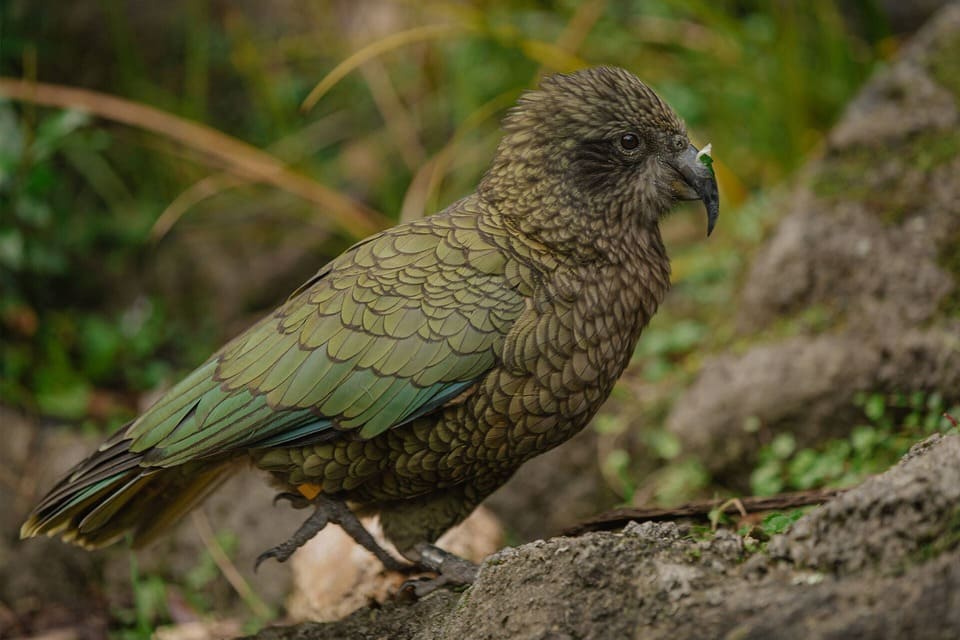
Kea are the only alpine parrots in the world, living in the rugged high-country of the South Island. Kea can solve logical puzzles, such as pushing and pulling things in a certain order to get to food, and will work together to achieve a certain objective. Their decision-making abilities have been compared to primates. Kea can wait up to 160 seconds for a more preferred reward demonstrating impulse control that most humans find difficult before their morning coffee.
The intelligence comes at a social cost to anyone visiting alpine areas. Kea will systematically dismantle windscreen wipers, peel rubber seals off car doors, steal sandwiches mid-bite, and roll stones onto hut roofs to keep trampers awake at night. This is not random — it’s play. They are extremely inquisitive, appear to enjoy problem-solving, and engage in playful activities, seemingly for fun.
The species almost didn’t survive. A bounty was paid for each bird killed. Between the 1860s and 1970, humans killed at least 150,000 kea. They had learned to eat the fat from live sheep, and farmers treated the behaviour as justification for near-extermination. The kea received absolute protection under the Wildlife Act only in 1986. Today, DOC estimates there are between 3,000 and 7,000 kea left in New Zealand a precarious number for one of the planet’s most cognitively sophisticated birds.
The best places to encounter them are around the Homer Tunnel and Monkey Creek area on the road to Milford Sound, and at Arthur’s Pass in the South Island’s Southern Alps. Hold onto your lunch.
What Makes NZ Wildlife Unique
Most travel content about New Zealand wildlife presents these species as individual curiosities. The more interesting story is the pattern they reveal when you put them together:
| Species | Evolutionary age | Why it exists only in NZ |
|---|---|---|
| Wētā | ~190 million years | Filled rodent niches; no mammal competition |
| Tuatara | ~250 million years | Only survivor of ancient reptile order; predator-free islands |
| Glowworm | Unique to NZ | Endemic species of fungus gnat; damp cave ecology |
| Kea | ~5 million years | Alpine adaptation without mammalian predators |
Every entry in that table is a species that survived in New Zealand precisely because the country lacked the mammals that would have displaced or eaten them elsewhere. The isolation that makes New Zealand so geologically dramatic also created the conditions for an alternative evolutionary path — one that mammals never disrupted until humans arrived.
The Other Side: New Zealand’s Remarkable Flora
Wildlife gets most of the attention, but New Zealand’s plant life is equally strange. The country has around 2,400 native plant species, of which roughly 80% are found nowhere else on earth. A few deserve particular mention.
The pōhutukawa tree, known as the New Zealand Christmas tree, flowers in crimson across coastal cliffs in December and January. In Māori cosmology, as discussed earlier in this series, the pōhutukawa at Cape Rēinga is the tree down which departing spirits climb to reach the afterlife. The tree’s relationship with human meaning in New Zealand runs as deep as its roots in the cliff face.
The kauri tree is among the largest trees on earth by volume, and some individuals are over 2,000 years old. Tāne Mahuta in the Waipoua Forest is the largest known living kauri — its canopy covering an area roughly the size of a tennis court. Kauri now face a new threat: kauri dieback disease, caused by a water mould, is spreading through forests and has no cure. Visitors to kauri forests are required to clean their footwear at designated stations — an unusual but necessary piece of conservation infrastructure.
The silver fern (ponga) is the national symbol and the image on the All Blacks jersey. In the bush, it has a practical use that sounds like folklore but is entirely real: the underside of the frond is a bright silver-white that reflects moonlight, allowing anyone who has turned a few fronds face-down along a path to follow that path back through dark forest. New Zealand’s native people used this technique before torches existed. The plant is literally a natural navigation tool.
Why This Matters More Than It Might Seem
New Zealand’s weird wildlife isn’t just interesting — it’s scientifically irreplaceable. The tuatara’s genome has already helped researchers understand how amniotes evolved. The glowworm’s bioluminescent chemistry is genuinely distinct from every other light-producing organism on earth. The kea is one of only a handful of non-human species demonstrating what researchers call “prosocial decision-making” — choosing outcomes that benefit other individuals even without personal reward.
This is a country-sized natural laboratory, 80 million years in the making. The loss of any of these species isn’t just an environmental tragedy — it’s the permanent deletion of data that took geological time to accumulate. Most visitors see kea at a car park and laugh. That’s fine. But underneath the comedy is one of the most extraordinary evolutionary stories on the planet, playing out in real time, on islands at the bottom of the world.